• gs maddala introduction to econometrics pdf

Gs Maddala Introduction To Econometrics Pdf May 2026

Fr. Seraphim Holland

Gs Maddala Introduction To Econometrics Pdf May 2026

As dusk fell, Asha realized the PDF had done more than teach her methods; it had offered a companionable mentor on a rainy evening. She made a plan: summarize the key examples, redo the proofs by hand, and apply one model to her housing data for her upcoming assignment. Before closing the laptop, she saved the scanned PDF into a folder titled “econometrics — classics,” and added a new sticky note: “Ask Prof. Kim about Maddala’s IV example.”

Asha downloaded the file and watched the progress bar crawl. When the PDF finally opened, it felt unexpectedly intimate: the author’s crisp explanations, the patient derivations, the examples that bridged abstract math and real economic questions. She read the preface, where Maddala wrote about the joy of teaching applied methods to curious minds. The tone reassured her — econometrics wasn’t just equations, it was a way to ask better questions about the world.

Inspired, Asha brewed a fresh cup of tea and opened her own dataset: local housing prices and transit access. She replicated Maddala’s step-by-step regressions, translating his textbook examples into her city’s numbers. Each coefficient she estimated felt less like a number and more like an observation about people’s lives — the value of a morning commute saved, the premium for being near a reliable bus line. gs maddala introduction to econometrics pdf

On a rainy March afternoon, Asha sat at her kitchen table surrounded by sticky notes and half-drunk tea cups. She’d spent the morning re-reading her econometrics lecture slides, but something felt missing — the quiet authority of a classic text. Her professor had mentioned, almost reverently, “Maddala’s Introduction to Econometrics,” and Asha realized she’d never actually held the book that shaped so many econometrics minds.

Weeks later, in a seminar, she presented her housing-transit regression. The class asked rigorous questions; Asha answered, drawing on the confidence she’d gained from the book. Afterwards, Prof. Kim pulled her aside. “Where’d you get that intuition?” he asked. Asha smiled and tapped her laptop. “That old Maddala PDF,” she said. “It turned the math into stories I could use.” As dusk fell, Asha realized the PDF had

She opened her laptop and typed the phrase she’d heard whispered across study groups: “gs Maddala introduction to econometrics pdf.” The search results were a tangle of lecture notes, forum links, and a few scans of photocopied pages. One result led to an old course repository tucked away on a university site, where she found a partially scanned PDF — chapter headings intact, margins worn, a few penciled annotations visible on the preview.

The PDF remained imperfect — missing pages here and there, marginalia in faded ink — but its imperfections made it feel lived-in. For Asha, it was proof that knowledge often finds you in fragments: a scanned file on a drizzly day, a patient example in a chapter, the will to apply it. In the quiet glow of her screen, econometrics had become less a subject to pass and more a toolkit to describe the world — one regression, one careful assumption, one story at a time. Kim about Maddala’s IV example

One section caught her eye: an example applying ordinary least squares to labor market data. The dataset was simple, but the insights were not. Asha imagined a city’s labor market as a network of tiny decisions: a factory hiring one more worker, a family choosing between jobs, a policymaker deciding whether to raise the minimum wage. Maddala’s clear walk-through turned a messy tangle of variables into a story about causality and choice.

Fr. Seraphim Holland

Redeeming the Time

29 ноября 2015 г.

Bibliography:

Old Believer Sermon for the 25th Sunday after Pentecost (unpublished)

“Drops From the Living Water”, Bishop Augustinos

“The One Thing Needful”, Archbishop Andrei of Novo-Diveevo – Pp. 146-148

“Commentary on the Gospel of St. Luke”, St. Cyril, Patriarch of Alexandria, Pp. 287-290

“The Parable of the Good Samaritan”, Parish life, Fr Victor Potapov. Also available at http://www.stohndc.org/parables


[1] This homily was transcribed from one given On November 11, 1996 according to the church calendar (11/24 ns), being the Twenty Fifth Sunday after Pentecost, and the day appointed for the commemoration Holy Martyrs Menas of Egypt, Victor and Stephanida at Damascus and Vincent of Spain The Epistle reading appointed is Ephesians Eph 4:1-6, and the Gospel is Luke 10:25-37. There are some stylistic changes and minor corrections made and several footnotes have been added, but otherwise, it is essentially in a colloquial, “spoken” style. It is hoped that something in these words will help and edify the reader, but a sermon read from a page cannot enlighten a soul as much as attendance and reverent worship at the Vigil service, which prepares the soul for the Holy Liturgy, and the hearing of the scriptures and the preaching of them in the context of the Holy Divine Liturgy. In such circumstances the soul is enlightened much more than when words are read on a page.

[2] Luke 8:41-56 (read on the 24th Sunday after Pentecost)

[3] Luke 10:25

[4] Luke 11:42

[5] The Reading appointed for Martyr Menas and the other martyrs is Matthew 10:32-33,37-38,19:27-30. At the end of the reading, Christ says: “Verily I say unto you, That ye which have followed me, in the regeneration when the Son of man shall sit in the throne of his glory, ye also shall sit upon twelve thrones, judging the twelve tribes of Israel. And every one that hath forsaken houses, or brethren, or sisters, or father, or mother, or wife, or children, or lands, for my name’s sake, shall receive an hundredfold, and shall inherit everlasting life.” (Matthew 19:28-29).

[6] The story of the Rich man and Lazarus is in Luke 16:19-31, and is read on the 16th Sunday after Pentecost. The rich man, in hell, wanting to save his brothers, has the following discussion with the Holy Prophet Abraham: “I pray thee therefore, father, that thou wouldest send him to my father’s house: For I have five brethren; that he may testify unto them, lest they also come into this place of torment. Abraham saith unto him, They have Moses and the prophets; let them hear them. And he said, Nay, father Abraham: but if one went unto them from the dead, they will repent. And he said unto him, If they hear not Moses and the prophets, neither will they be persuaded, though one rose from the dead.” (Luke 19:27-31)

[7] Luke 10:26-27 (cf. Duet 6:5: “And thou shalt love the LORD thy God with all thine heart, and with all thy soul, and with all thy might.”

[8] Mark 12:31

[9] John 13:34-35

[10] Luke 10:28

[11] Cf. Matthew 18:22. This expression, “seventy times seven” is an indication of an infinite number.

[12] Luke 10:29

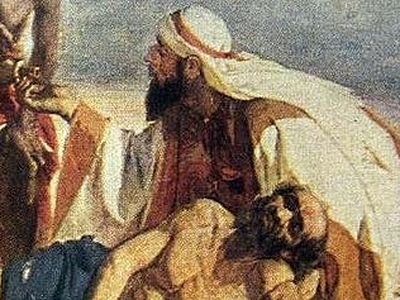
[13] Luke 10:30

[14] Psalm 48:1-2

[15] Luke 10:31-32

[16] Luke 10:33

[17] Luke 10:34

[18] The Gospel for the 24th Sunday after Pentecost, read the preceding week, is Luke 8:41-56. It tells the story of the healing of the woman with an issue of blood, and the raising of Jairus’ daughter.

[19] John 14:2-3

[20] John 15:14-17

[21] Matthew 11:29-30

[22] Matthew 7:13-14

[23] Matthew 7:21

[24] Matthew 10:32-33

[25] Luke 10:35

[26] Cf. 1 Cor. 3:6 “I have planted, Apollos watered; but God gave the increase.”

[27] Cf. Mark 9:41 “For whosoever shall give you a cup of water to drink in my name, because ye belong to Christ, verily I say unto you, he shall not lose his reward.”

Храм Новомученников Церкви Русской. Внести лепту
Комментарии
Castrese Tipaldi 2 декабря 2015, 15:00
This is a very beautiful sermon, indeed, but maybe a few more words would be needed about the fact that the figure of Christ here is a Samaritan.
Здесь Вы можете оставить свой комментарий к данной статье. Все комментарии будут прочитаны редакцией портала Православие.Ru.
Войдите через FaceBook ВКонтакте Яндекс Mail.Ru Google или введите свои данные:
Ваше имя:
Ваш email:
Введите число, напечатанное на картинке gs maddala introduction to econometrics pdf